

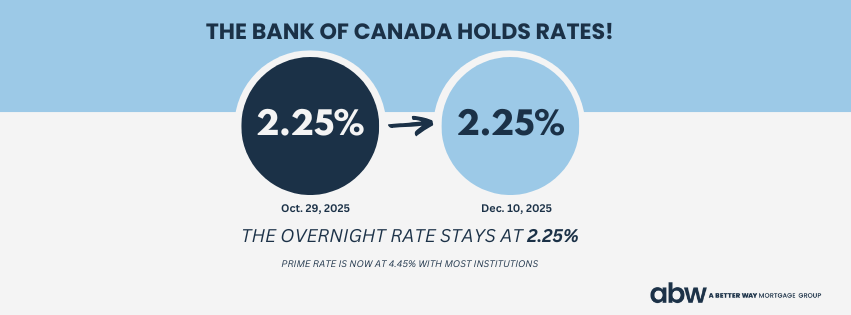
12/10/2025:

BoC Holds at 2.25%: Stability Takes Centre Stage as Canada Enters 2026

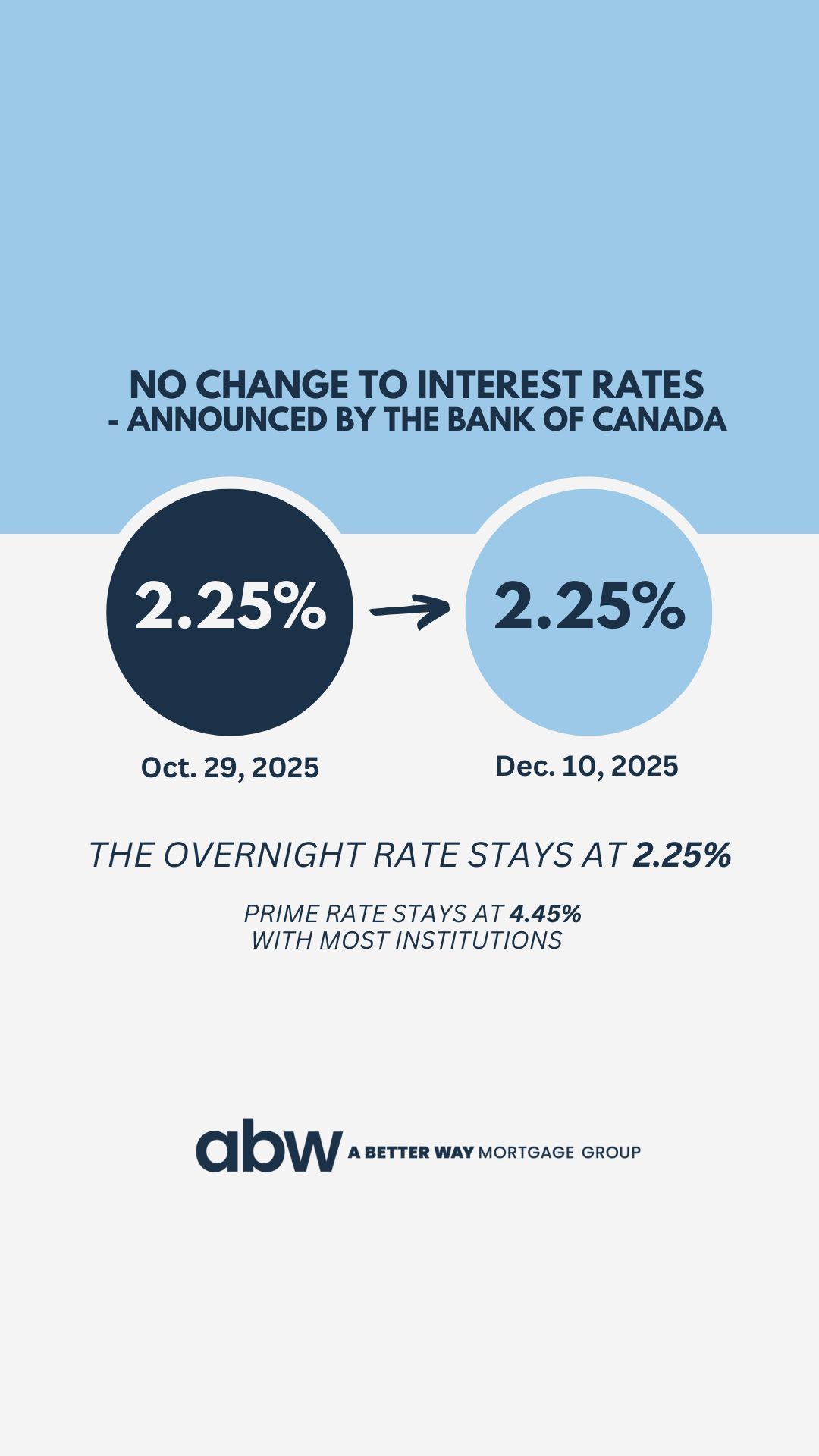
Today, the Bank of Canada (BoC) held its overnight rate at 2.25%, maintaining the Bank Rate at 2.50% and the deposit rate at 2.20%. After October’s widely expected rate cut, today’s decision confirms a shift in stance: the Governing Council believes policy is “at about the right level” to guide inflation back to target while supporting an economy undergoing structural adjustment.


This hold marks the first step into Canada’s rate-stabilization phase—a period where economic data, not policy momentum, will drive market direction.


Economic Context and Market Impact


Global Backdrop: Resilience With Risk


Major economies continue to absorb the shockwaves of U.S. trade protectionism, but impacts vary:


  • United States: Growth is holding up, fuelled by strong consumption and a surge in AI-driven business investment. Tariffs continue to apply upward pressure on inflation. A prolonged government shutdown distorted quarterly data releases.


  • Euro Area: A surprisingly robust services sector is lifting growth above expectations.


  • China: Persistent housing weakness and soft domestic demand weigh on overall momentum.


Canada: A Stronger Q3, But Not a Trend

Canada posted a surprising 2.6% GDP expansion in Q3—though mostly due to volatile trade flows, not underlying domestic strength.


  • Final domestic demand was flat, reflecting cautious consumer and business spending.
  • The BoC expects weaker GDP in Q4, as net exports reverse.
  • Growth is projected to pick up in 2026, but volatility may continue given trade-related shocks.


Labour Market: Gradual Improvement

  • Employment has grown steadily over the past three months.
  • The unemployment rate dipped to 6.5% in November.
  • However, trade-exposed sectors remain soft, and hiring intentions remain subdued.


Inflation: Moving in the Right Direction

  • Headline CPI: 2.2% (October), helped by falling gas prices and slower food inflation.
  • Core Measures: Still between 2.5%–3.0%, with underlying inflation assessed at ~2.5%.
  • Temporary upward bumps are expected due to last year’s GST/HST holiday, but the Bank believes economic slack will hold CPI near target through 2026


Financial Markets: Steady Conditions Amid Policy Pause

Financial markets have taken today’s hold largely in stride, with minimal movement in bond yields and credit spreads. Investors had already priced in a pause, and the BoC’s reaffirmation that policy is “at about the right level” supports expectations for a stable rate environment heading into early 2026. Funding conditions remain broadly unchanged, reinforcing a backdrop where fixed mortgage rates are likely to experience only modest fluctuations in the near term.


Business Confidence and Investment Outlook

Business sentiment remains cautious but stable as firms adjust to ongoing trade uncertainty and shifting global supply chains. While hiring intentions are subdued, the Bank notes that investment tied to technological modernization continues to provide some support, echoing trends seen in the U.S. AI sector. Overall, the BoC expects business activity to remain soft in the short term but improve gradually as economic conditions firm later in 2026.


Impact on Borrowers

Variable-rate mortgage and HELOC holders will see no change to payments as today’s hold keeps prime at 4.45%. The stability offers an opportunity for borrowers to reassess amortization and repayment strategies now that the easing cycle appears to be on pause. Fixed-rate borrowers can expect rate stability in the near term, with limited upward pressure unless bond yields drift higher. Those with static-payment variable products may see gradual improvements in amortization as rates stabilize. Adjustable-rate variable borrowers will experience no payment changes but benefit from increased predictability heading into 2026.


What’s Next?

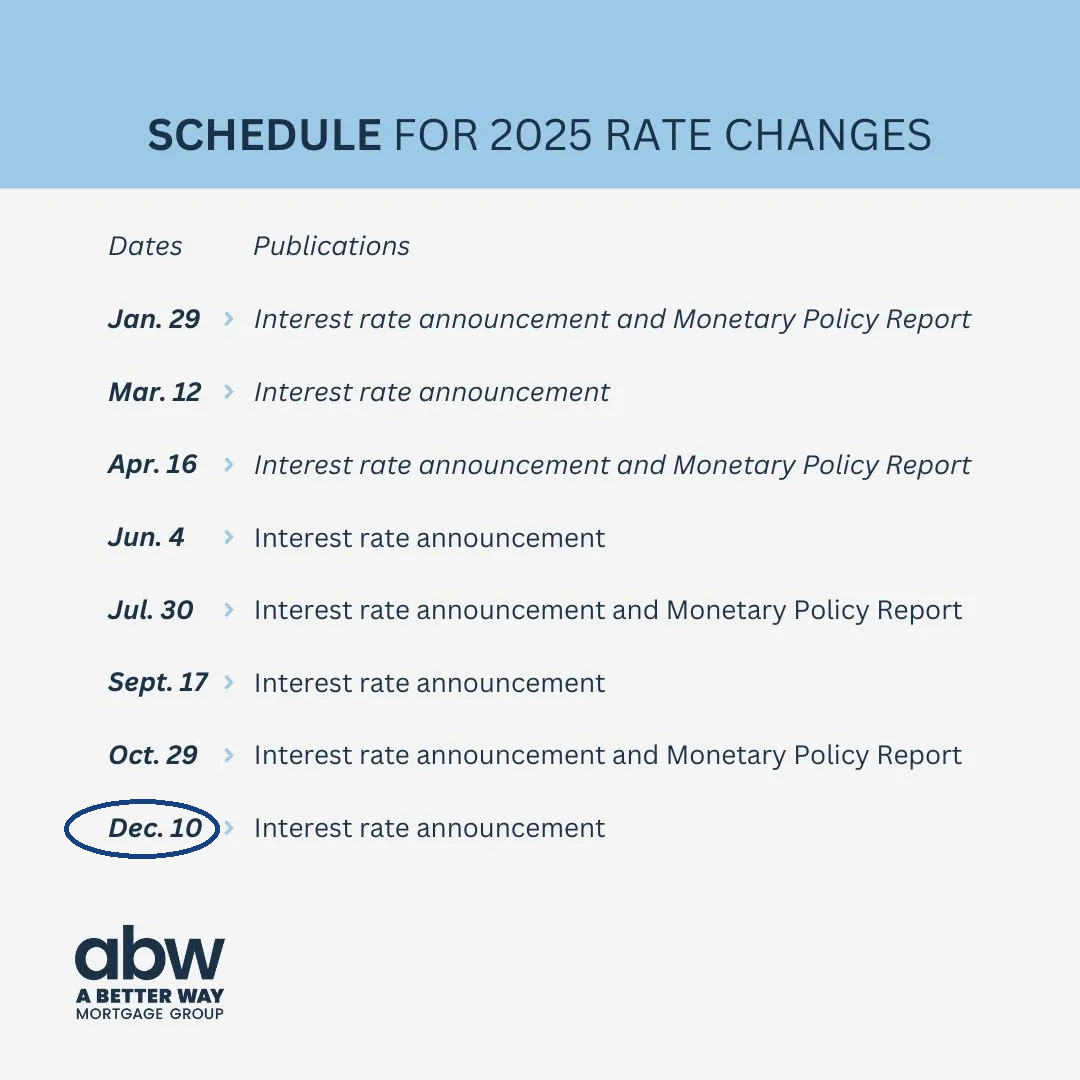
The next BoC meeting is scheduled for January 28, 2026, and market expectations for a rate cut are minimal. With policymakers emphasizing that the current rate is appropriate for maintaining inflation near target, the consensus is that the BoC has entered a holding phase unless economic conditions deteriorate significantly.


Upcoming inflation data will be critical, particularly core readings, as markets look for further confirmation that price pressures remain contained. As Canada moves into 2026, the focus is shifting away from rate movements and toward how the economy adapts to ongoing trade reconfiguration and global uncertainty.

Opportunities for Mortgage Brokers

Today’s hold — and the BoC’s signal that policy is now “at about the right level” — creates a strategic moment for brokers to help clients adjust expectations as Canada enters a period of rate stability:


  • Proactive Client Outreach: Connect with variable-rate and HELOC clients to explain what today’s hold means for their payments and amortization. Reinforce the message that stability is returning to the rate environment, and use this moment to prompt early renewal conversations for clients coming up in 2026.
  • Educational Content: Share simple, visual explanations of why the BoC is shifting into a stabilization phase. Highlight improving inflation trends, the flat domestic demand picture, and the Bank’s confidence that CPI will remain near target. These updates help clients understand why sharp rate swings are less likely in the near term.
  • Targeted Marketing: Focus outreach in regions showing renewed buyer interest, particularly Ontario and British Columbia. Emphasize that stable policy rates provide clarity for planning, and encourage clients to secure pre-approvals while fixed-rate pricing remains steady.
  • Renewal & Refinance Strategy: Guide clients within 120 days of renewal to review options early. With rates holding steady, borrowers can make informed decisions about term selection, payment strategy, and potential debt consolidation. The current environment is also well-suited for clients looking to improve cash flow or consolidate higher-interest consumer debt.
  • Stay Ahead of the Data: Continue monitoring upcoming inflation prints, labour market reports, and global trade developments. Core inflation drifting lower would reinforce the BoC’s hold stance, while unexpected trade disruptions could shift market expectations. Keep an eye on the 5-Year Canada Bond and key U.S. Treasury yields for signs of fixed-rate movement heading into 2026.


TAKE ACTION!

At ABW Mortgage Group, we’re here to help you make the most of this period of renewed stability. Whether you’re buying, refinancing, or renewing, our experts can guide you through today’s shifting landscape with clarity and confidence.


Now is the perfect time to leverage the benefits of a steady rate environment — secure favourable terms, protect your borrowing power, and plan strategically for 2026.


maximize the rate cut’s benefits!



55: Behind the Network with Chad Gregory, Dominion Lending Centres


Guest: Chad Gregory

Hosts: Dean Lawton & Jason Marshall


Chad Gregory, VP of National Sales at Dominion Lending Centres, joins Behind the Network to share how DLC grew from a small startup into Canada’s largest mortgage brand. Chad reflects on DLC’s early days—building the network from the ground up in Ontario, knocking on doors, pitching real estate brokerages, and pushing a bold vision: establish the first nationally recognized mortgage-broker brand. He explains how DLC’s branding strategy, recruiting efforts, and relentless belief in the model helped shift consumer behaviour from 88% bank loyalty to a near 50/50 split between banks and brokers today.


The conversation dives into the tools that now fuel DLC’s competitive edge, including Velocity, the My Mortgage Toolbox app, and the Gold Rush CRM. Chad details how secure document portals, refinance analyzers, automated campaigns, and emerging AI integrations are helping brokers become more efficient, more professional, and better equipped to convert and retain clients. He emphasizes that in a fast-changing market, brokers who embrace technology—and invest in systems that buy back their time—will outperform those who resist change.


Chad also shares timeless sales and business-development strategies, from handwritten cards and emotional deposits to using scripts, practicing role plays, and delivering unexpected post-close touches. These simple habits, he says, turn clients and referral partners into long-term raving fans. Looking ahead, Chad believes DLC’s biggest years are still to come, driven by innovation, consumer demand for advice, and a network committed to helping brokers grow.


WATCH OR LISTEN HERE


Choose to Receive the ABW Memo

This is a choice-based resource. If you'd like to continue receiving these updates weekly, please register here:
Click here to subscribe to the ABW Tuesday Mortgage Memo


We look forward to helping you stay ahead of the market in 2025.


By Dean Lawton February 12, 2026
Episode 60 — Broker Armour #2: Suitability, Documentation & Protecting Your License HOSTS: Deryk Williamson & Justin Noda (Chief Compliance & Operations Officer, ABW) What This Episode Covers In this episode of Broker Armor, Justin Noda is joined by Deryk Williamson to tackle a topic that’s becoming increasingly important in today’s regulatory climate: how to protect your business, your income, and your license from E&O claims. The focus isn’t on how to make more money—it’s on how to keep it. You Can Do Everything Right… and Still Get Sued One of the most important reminders from this conversation is simple: even if you secure a great rate, close on time, and deliver strong service, you can still face a claim years later. Clients can sue for many reasons—sometimes justified, sometimes emotional, sometimes financial. When that happens, the question won’t be whether you’re a good broker. It will be whether you can prove what happened. That’s where what Justin calls the “paper shield” comes in. Your protection isn’t your memory—it’s your documentation. Communication Is Your First Line of Defense A major theme of the episode is communication retention. If it’s not written down, it effectively didn’t happen. Regulators and lawyers will look for emails, texts, CRM notes, and any record of advice provided. The discussion emphasizes keeping communication clean and centralized—ideally through email—and following up important phone calls with written recap summaries. Notes should be detailed and written as if a lawyer or judge will read them years later. Even something as simple as copying all borrowers on key updates—not just the primary contact—can prevent misunderstandings that later become claims. What feels like a small administrative step today can become critical evidence tomorrow. Suitability vs. Eligibility Another central topic is suitability—a word that brokers can no longer afford to ignore. Eligibility answers the question: Can the client qualify? Suitability answers the more important question: Should they take this product? Many E&O claims stem from clients later saying they didn’t fully understand the risks of the product they chose—whether it was a variable rate during rising markets, a short-term mortgage during volatility, or a private loan with significant renewal fees. Suitability forms help document the advice provided, the risks discussed, and the client’s informed decision. They are not just another form to sign—they are evidence that education happened and that the client ultimately chose their path forward. As discussed in the episode, “We educate. The client decides.” But that decision must be documented. Enhanced Consent & Setting Expectations Early The episode also highlights the growing importance of enhanced consent forms. Consent is no longer just about pulling credit—it includes permission to share information, outline engagement terms, and clearly define the relationship. Timing matters. These documents should be signed at the beginning of the process—not at closing and certainly not after an issue arises. Setting expectations early creates clarity for the client and protection for the broker. When a Claim HappenS The final portion of the episode addresses crisis management. If you receive a claim notice, immediate notification to your brokerage and E&O provider is critical. Do not admit fault. Follow your brokerage protocol. Once involved, E&O providers assign claims adjusters and legal counsel. But the strength of your defense will come back to one thing: your documentation. Clear CRM notes, recap emails, signed suitability forms, and properly executed consent documents can significantly change the trajectory of a claim. Why This Matters in 2025 Compliance expectations are rising. Alternative and private lending is more common. Suitability conversations are under greater scrutiny. Professional brokers today must operate with both growth and protection in mind. Strong communication habits, documented advice, and disciplined processes are no longer optional—they are essential to long-term sustainability. Why You Should Listen This episode is a practical, real-world guide to building a defensible mortgage business. If you want to reduce risk, strengthen your processes, and protect your livelihood in an evolving regulatory environment, this conversation is essential listening.. For weekly market updates, sign up for the ABW Tuesday Mortgage Memo . If you’re a broker considering a network change or looking to grow, reach out to us to explore how we can support your success.
By Dean Lawton February 10, 2026
02/10/2026 Tuesday Mortgage Memo: Your Weekly Market Highlights
By Dean Lawton February 3, 2026
02/03/2026 Tuesday Mortgage Memo: Your Weekly Market Highlights
By Dean Lawton January 29, 2026
Episode 59 — Broker Armour #1: FINTRAC One Year Later (Are You Protected?) SERIES LAUNCH: Broker Armour HOSTS: Dean Lawton & Justin Noda (Chief Compliance & Operations Officer, ABW) What This Episode Covers Episode 59 kicks off Broker Armor, a brand-new series built specifically to help Canadian mortgage brokers stay protected, prepared, and compliant in a rapidly tightening regulatory environment. Dean sets the stage for what this series will become: a monthly (or more) “compliance home base” covering FINTRAC, provincial regulators, and upcoming changes—especially in BC with the MSA/BCFSA evolution. This first episode is deliberately “foundational.” Dean and Justin focus on one of the biggest points of confusion in the industry: FINTRAC’s requirements are primarily aimed at the brokerage (the reporting entity), not the individual agent—yet agents still carry meaningful responsibility inside each file. The conversation walks through a practical checklist that clearly separates brokerage responsibilities vs. broker responsibilities, with real-world examples of what gets missed, what triggers risk, and what could cause major issues during an audit. A downloadable checklist is mentioned in the show notes as a take-home tool that brokers and owners can use to self-audit their readiness. The Big “Aha”: Brokerage vs. Agent Responsibilities Justin makes it crystal clear early: FINTRAC refers to “reporting entities,” and that means the brokerage . This matters because the brokerage must register, access the FINTRAC web reporting system, build programs, train agents, keep records, and file reports. Agents should not be filing reports directly. Instead, agents are expected to follow the brokerage’s procedures, complete the KYC steps correctly, and escalate anything suspicious. This single distinction can expose a huge gap in many brokerages. If a broker doesn’t know who their compliance/AML lead is, doesn’t know where the policies are, or hasn’t been trained beyond the initial rollout in October 2024, that’s not just an education issue—it’s a risk issue. Broker ArmoUr Checklist — What Needs to Exist (and Who Owns It) 1. Appointed Compliance / AML Officer (Brokerage Responsibility) A major theme: this role can’t be an afterthought anymore. Justin explains that many firms historically treated compliance as part-time admin work. In today’s environment, that approach is dangerous. The compliance lead needs to be someone who is genuinely engaged, capable, and supported—because the workload is real, audits are coming, and the expectations are rising. Broker responsibility: know who this person is, respect the process, and actually use them as a resource. A simple self-check mentioned in spirit: Do you know your compliance officer’s name today? 2. Written Policies & Procedures Manual (PPM) — Brokerage Builds It / Brokers Follow It The PPM is effectively the brokerage’s FINTRAC “playbook.” It lays out how the brokerage interprets the rules and how brokers are expected to operate inside the program (ID methods, enhanced due diligence, documentation, escalation, etc.). Justin makes a key point: FINTRAC rules are clear, but the “how” can vary—so each brokerage must define their approach and then operate consistently. Broker responsibility: read it, acknowledge it, follow it. (And if your brokerage can’t easily provide it, that’s an immediate red flag.) 3. Risk-Based Assessment (RBA) — Brokerage Defines Risk Appetite / Brokers Need to Understand It Justin distinguishes two commonly confused items: RBA (Risk-Based Assessment): brokerage-level document that defines the firm’s risk appetite and approach Client Risk Assessment: file-level decision brokers make (high/medium/low risk) The RBA informs how the brokerage wants risk measured and what steps are required when risk increases. Justin explains how ABW built tools (like a scorecard approach) to drive consistent risk ratings and reduce “gut-feel only” decisions—because inconsistency creates exposure in audits. Broker responsibility: understand the risk factors and collect the info needed to rate a file properly. 4. Ongoing Training Program (Brokerage Must Run It / Brokers Must Complete It) This episode strongly reinforces: training isn’t a one-time rollout. Brokerages need an annual training program, documented and trackable, so they can prove education happened if issues arise later. Justin notes many firms haven’t built this properly yet because “the year felt far away”—but FINTRAC’s expectations are now moving into the “you should know this by now” stage. Broker responsibility: complete the training and apply it in real files. The subtext is important: ignorance won’t be a defensible position going forward. 5. Two-Year Effectiveness Review (Brokerage Responsibility — and It’s Coming Fast) This one is a major “heads up.” FINTRAC requires a formal effectiveness review every two years, where an appropriately qualified reviewer evaluates whether the brokerage program actually works. It can’t be done by the same person who built the program, and it’s often not cheap—Justin notes it can run well into five figures depending on scope and size. Broker responsibility: none directly—other than cooperating if asked and adapting to changes that follow the review. 6. Client ID + Beneficial Ownership (Shared Responsibility) This is where brokers feel FINTRAC most day-to-day. Client ID must follow an approved method (and must be valid/current). Justin shares examples of how things go sideways when brokers treat ID casually. Beneficial ownership becomes critical in business-for-self files or corporate entities, especially where someone owns 25%+ but isn’t on the mortgage. That’s not an automatic “no”—it’s a documentation and transparency requirement. Brokerage responsibility: define acceptable methods and provide tools/process Broker responsibility: execute correctly, document properly, and do it early (not at the end) 7. PEP / HIO Screening + Sanctions (Shared Responsibility) This is another major pillar: screening for Politically Exposed Persons (PEPs) and Heads of International Organizations (HIOs), plus sanctions checks. Justin explains that the brokerage must provide the mechanism (forms, platform tools, or paid screening options), but brokers must actually run it and escalate when results require extra due diligence. A key nuance highlighted: foreign vs. domestic PEPs are treated differently, and when a potential match appears, brokers may need to do deeper confirmation (e.g., verifying it’s a different person with the same name). Justin shares that the work can get unexpectedly serious—examples included links to sanctioned geographies, adverse media, and crypto-related laundering attempts. The point is clear: these aren’t theoretical risks anymore. 8. Ongoing Monitoring + Suspicious Activity (Mostly Brokerage, But Brokers Must Be Alert) Justin explains ongoing monitoring is largely brokerage-driven and is typically tied to the risk rating: high-risk clients may require more frequent re-checks. Brokers don’t run monitoring programs, but brokers absolutely impact them by assigning accurate risk levels at the start and flagging anything unusual. For suspicious activity: brokers are the “front line.” If something feels off, brokers should escalate internally—never ignore it, never try to quietly push a file through. 9. Record Keeping (5+ Years) — Shared Responsibility This is straightforward but critical: brokerages must securely store required documents for 5+ years, and brokers must ensure the documentation is complete and uploaded properly. A future audit will compare what’s in your PPM/RBA against what’s in your actual files. 10. Reporting to FINTRAC (Brokerage Only) Justin reinforces a common misconception: brokers do not file FINTRAC reports directly. Broker responsibility is to raise concerns internally using the brokerage’s process (internal STR form, escalation workflow, etc.). The brokerage then decides whether to file official reports through the FINTRAC reporting system. 11. FINTRAC Examinations / Audits (They’re Already Starting) This is the tone-setter near the end: audits have begun, and while the early phase may not be “hammer down,” FINTRAC is making expectations known. Justin also notes proposed legislative changes that could massively increase penalties—making today’s discipline the difference between a manageable process and a catastrophic one later. Dean adds a key industry-level point: if someone gets made an example of, it’s not just bad for them—it’s bad for the entire channel. 11. FINTRAC Examinations / Audits (They’re Already Starting) Justin notes most brokers now understand the “standard pillars” (ID, PEP, sanctions, basic risk rating), but where gaps show up is in the deeper risk logic—things like: Beneficial ownership and corporate control Third-party involvement (who is really directing the transaction) High-risk industries or unusual sources of funds Risk patterns that don’t show up in the obvious checklist items His framing is useful: these risks always existed—brokers are just being forced to see them clearly now. Action Steps for Brokers This Week If you want this episode to actually protect you (not just educate you), here’s the practical follow-through that aligns with what Dean and Justin are pushing: Download the checklist and walk through it with your brokerage in mind Confirm you know your compliance/AML lead and how to escalate concerns Ask where your PPM + RBA live and whether you’ve acknowledged them Make sure your ID method is brokerage-approved (and documented correctly) Stop treating risk assessment like “gut feel” —collect the facts that support the rating Escalate anything that feels off early (before it becomes a “cleanup after the fact” situation) Justin also openly invites brokers and broker owners to reach out confidentially if they’re unsure whether their current setup is truly compliant. Why You Should Listen This episode is a reality check—and a protection plan. If you’re treating FINTRAC as a “box-checking exercise,” you’re exposed. Justin breaks down what FINTRAC actually expects, what your brokerage must have in place, what you personally must execute inside the file, and why audits (and penalties) are only getting stricter from here. If you want to keep your license safe , avoid becoming the brokerage that gets made an example of, and understand compliance in a way that’s practical—not theoretical—Episode 59 is required listening. For weekly market updates, sign up for the ABW Tuesday Mortgage Memo . If you’re a broker considering a network change or looking to grow, reach out to us to explore how we can support your success.
By Dean Lawton January 28, 2026
01/28/2026: BoC Holds at 2.25%: A Measured Pause as Policy Nears Its Destination
By Dean Lawton January 28, 2026
01/27/2026 Tuesday Mortgage Memo: Your Weekly Market Highlights
By Dean Lawton January 21, 2026
01/20/2026 Tuesday Mortgage Memo: Your Weekly Market Highlights
By Dean Lawton January 15, 2026
EPISODE 58: A Year in Review - National Leadership Team A Better Way Mortgage Group By: Dean, Jason & Deryk A Different Energy Entering 2026 2025 was a milestone year for A Better Way Mortgage Group—and this “Year in Review” episode pulls back the curtain on what actually drove the momentum. Dean, Jason, and Deryk reflect on a year that felt noticeably different than the previous cycle: more optimism, stronger broker engagement, better energy at events, and a renewed sense that the industry has found its rhythm again. They’re candid that this episode includes some celebration of the team’s wins—but the real intent is to share lessons, strategy, and what’s coming next for brokers who want to keep building in a changing market. Where the Market Shifted — And Where Opportunity Showed Up A big theme throughout the conversation is how brokers adapted to the realities of today’s lending environment. The team highlights a major shift toward alternative lending, private solutions, reverse mortgages, and a more strategic focus on where opportunity exists—especially in segments where brokers aren’t constantly competing with non-channel banks. They also unpack the “renewal wave” with a realistic lens: you’re not going to win every renewal, but the sheer volume of maturities means even a modest capture rate can materially change a broker’s year. The takeaway is simple: deals are still there, but brokers who win are the ones who stay educated, broaden their skill set, and lean into new lanes of business. The Numbers Behind the Record Year The stats tell the story of a brokerage that scaled—without losing structure. A Better Way funded $4.1B in 2025, up $1.3B year-over-year, and served 1,900+ additional families compared to the year prior. They also celebrate a protection milestone that matters: 300 more families secured mortgage protection insurance (MPP), reinforcing the brokerage’s focus on not just closing mortgages, but protecting clients long term. Growth came from both directions—existing agents expanding their books through training and tools, and new high-performing talent joining from other brokerages and bank channels. Scaling Without Chaos: Compliance, Ops, and Support Roles To support that level of production, the episode dives into the infrastructure upgrades made behind the scenes—particularly in compliance, onboarding, operations, and AML/FINTRAC readiness. The team outlines key hires and internal role improvements that helped strengthen the brokerage’s ability to scale responsibly, protect agents, and reduce friction. They also emphasize that training remains the backbone of the culture: 95 lender presentations, 22 business sessions, weekly internal updates, and the continued distribution of the ABW Tuesday Mortgage Memo—a public-facing market recap many brokers now repurpose into their own content and referral-partner communication. Community, Events, and Why Culture Drives Performance To close, the team previews a bigger year ahead—more podcast expansion (including Justin Noda’s upcoming “Broker Armor” series), more content formats (studio and virtual), more training opened to the broader industry, and deeper system improvements through DLCG tools and dedicated support. It’s equal parts reflection and roadmap—an inside look at what worked in 2025, why it worked, and how brokers can carry that momentum into 2026. Looking Ahead: More Content, More Training, More Tools On the tactical side, Alfredo breaks down what he uses daily: Velocity, Gold Rush CRM, Lender Spotlight, DocuSign, and Penalty Mentor for quick penalty estimates and client visuals. He also stresses the value of lender relationships—BDMs, underwriters, and mortgage teams aren’t barriers; they’re partners. His learning stack includes Mortgage Logic News, regulatory updates (including FSRA/FISRA), and using AI to summarize industry updates into client- and referral-partner-friendly talking points. Why You Should Listen If you’re a broker looking for a real-world playbook on how top teams are growing in a “tough” market, this episode is packed with practical insight. It’s not just numbers—it’s the strategy behind alternative growth, renewal opportunity, training discipline, compliance readiness, and building a culture that keeps brokers engaged, learning, and winning year after year. For weekly market updates, sign up for the ABW Tuesday Mortgage Memo . If you’re a broker considering a network change or looking to grow, reach out to us to explore how we can support your success.
By Dean Lawton January 14, 2026
01/13/2026 Tuesday Mortgage Memo: Your Weekly Market Highlights
By Dean Lawton December 31, 2025
EPISODE 57: Behind the Broker with Alfredo Torres Guest: Alfredo Torres Hosts: Dean Lawton & Jason Marshall From Service-First Roots to Mortgage Brokering Alfredo’s story starts long before mortgages—rooted in acts of service and a natural desire to help. From sweeping hair as a kid, to years at McDonald’s (including “McDonald’s University”), Alfredo learned early how systems, consistency, and customer experience shape success. That same mindset carried into a nine-year career at TD, where he built a strong foundation across lending, investments, and client communication. The Pivot: Leaving the Bank and Finding the Broker Path When bank “optimization” created uncertainty, Alfredo made a proactive decision: get ahead of the change and take ownership of his next chapter. What followed was an unexpected—and very organic—transition into brokering. A few mortgage brokers began reaching out, lunches turned into real conversations, and soon Alfredo was mapping out his exit strategy into a brokerage environment where he could keep growing while serving clients in a bigger way.. Why Alfredo Thrives at A Better Way A major theme in the episode is culture. Alfredo shares how refreshing it’s been to step into an environment built on support, trust, and growth without judgment. He highlights the advantage ABW brokers have with training and structure—especially the Perfect Loan Process—and points out a truth many overlook: the tools and resources are already available; the difference is the discipline to use them. The Top 50 leaderboard comes up as a powerful motivator too—not as pressure, but as a catalyst for accountability, community, and shared momentum. Communication as the Real Competitive Advantage One of the strongest segments dives into Alfredo’s approach to client relationships. His focus is on building rapport not just consciously, but unconsciously—by speaking in the “model of the world” clients naturally communicate in. He shares how understanding communication styles can instantly lower stress, build trust, and create a smoother experience—especially in chaotic or high-pressure files. With AI becoming more present in the industry, Alfredo believes emotional intelligence and human connection will be even more valuable going forward. Wins That Create Clients for Life Alfredo shares memorable success stories that underline the power of brokering. From helping clients buy homes back in the day with 100% financing options, to guiding people through credit rebuild journeys and returning them to A-lending, he emphasizes that a broker’s role isn’t just closing a deal—it’s building a plan. When clients feel supported through a multi-year path, loyalty becomes automatic, and referrals follow naturally. Tools, Tips, and Staying Sharp On the tactical side, Alfredo breaks down what he uses daily: Velocity, Gold Rush CRM, Lender Spotlight, DocuSign, and Penalty Mentor for quick penalty estimates and client visuals. He also stresses the value of lender relationships—BDMs, underwriters, and mortgage teams aren’t barriers; they’re partners. His learning stack includes Mortgage Logic News, regulatory updates (including FSRA/FISRA), and using AI to summarize industry updates into client- and referral-partner-friendly talking points. Why You Should Listen This episode is a reminder that brokering is still a relationship business—and the brokers who win long-term are the ones who combine structure, communication, and service. If you want practical insight on how to build client trust faster, create raving fans, use systems like a pro, and stay motivated through the grind while keeping your life in balance, Alfredo’s playbook is worth hearing. For weekly market updates, sign up for the ABW Tuesday Mortgage Memo . If you’re a broker considering a network change or looking to grow, reach out to us to explore how we can support your success.